
Ever felt like someone was speaking the same language but somehow, you still misunderstood each other?
That’s the tricky part about cultural misunderstanding. It doesn’t always look like a language barrier. Often, it feels personal. Awkward pauses, mixed signals, or even total silence can leave you wondering: Did I do something wrong?
When you’re dating internationally, these moments are common. And the problem isn’t always what’s said, it’s what’s assumed. That’s where understanding the 4 types of cultural misunderstanding can help.
How to Date a Foreigner is the #1 resource and community helping expats, digital nomads, and students overseas confidently navigate international relationships.
As we explain in our guide to what makes international dating different, learning how different cultures think, communicate, and date can change everything.
Let’s explore four cultural misunderstanding examples and how understanding them can help you avoid heartbreak, confusion, or accidentally ghosting someone you liked.
What is a language-based cultural misunderstanding?
Language-based misunderstandings happen when people use the same word but interpret it differently because of their cultural background.
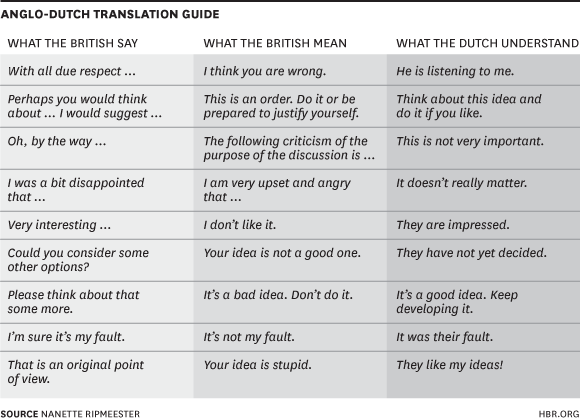
A classic example is the Anglo-Dutch Translation Guide. It shows how Brits might say “That’s a very brave proposal” when they actually mean “You must be mad.” A Dutch person might take that literally, as praise. Cue confusion.
A popular one is the Anglo-Dutch Translation Guide that has been circulating the internet in different forms:
Another moment that surprised me was when I asked my Vietnamese friend, “How do you date?”
We spent nearly two hours chatting before we realised that our understanding of dating was completely different.
In her culture, dating is everything that happens before a relationship. There’s a clear break between “dating” and “being together.”
In mine, dating becomes the relationship: it gradually grows into something serious, without needing a formal shift.
Then there’s the word “vulnerable.” To me, it means open, emotionally available. But I’ve met people from cultures where “vulnerable” suggests weakness. In a conversation about feelings, that creates an invisible wall.
Words carry emotion, not just meaning. And if you don’t know what someone feels when they hear a word, misunderstandings are almost inevitable.
How can behaviour cause confusion in international dating?
Cultural misunderstandings aren’t just about what we say, they’re often about what we do.
A friend of mine once dated an American guy. Early on, he told her she talked too much.
She was hurt. In her culture, talking more in the beginning shows you’re engaged and interested.
But in his dating culture, people warm up slowly. Lots of early chatter was unfamiliar, even uncomfortable.
Eventually, she relaxed and went quiet around him.
She felt safe, like she didn’t need to fill the silence anymore. He, on the other hand, panicked. Silence meant something was wrong. So he started going out of his way to cheer her up.
That just made her more confused, and soon, she thought she was the problem. She even asked if he wanted her to move out.
Same relationship. Same people. But their actions were being misread over and over again because they came from different norms.
What happens when words and behaviour contradict each other?
This type of misunderstanding happens when someone’s words and actions don’t line up, and the disconnect feels suspicious, even if it’s not.
A Vietnamese woman once told me she didn’t believe her British boyfriend when he said, “I love you.”
Not because she didn’t want to. But because it didn’t feel like he meant it.
In Vietnamese, there are different words for love—one for people and another for things. But her boyfriend used “love” for football, chicken, socks, and her. So the word didn’t feel special anymore.
Another time, I read about Oneika, a Black American traveller who was called “Negrita” in Mexico.
To her, the term was loaded with history and offence. But in Latin America, especially in Spanish and Portuguese-speaking regions, terms like “negro,” “gordo,” or “chino” are often affectionate. They mean closeness, not insult.
Dating brings this to light constantly.
One friend went on a date with an American guy she liked. He told her he liked her, then disappeared. To her, from Eastern Europe, that meant rejection. But in his dating culture, it was a strategy: don’t text too soon, or you’ll seem needy.
For one side, that silence meant disinterest, while to another, it was how dating worked.
Why are silent assumptions so dangerous in cross-cultural relationships?
This final type is the hardest to catch, because no one says anything but just assumes.
Like when a friend of mine was dating someone from Africa. One night, he texted her: “Get ready, we’re going out.”
She was a bit hungry but assumed they’d eat out. It was late, and in her experience (especially in low-cost Asian countries), people eat out all the time.
But when he got home, he was upset. Why hadn’t she cooked?
Turns out, he assumed they’d eat at home because where he grew up, eating out could be dangerous.
Restaurants weren’t for fun. They were last resorts. Food could be unsafe. You ate at home to protect yourself and save money.
So she felt rejected while he felt neglected. All because both assumed their way was obvious.
When you don’t talk about expectations, misunderstandings are guaranteed. When you are in an intercultural relationship, never assume. Always ask. It could save you from unnecessary arguments.
…and talking about food and cultural differences, we just couldn’t close this blog post without a funny video! Enjoy!
FAQ
What is a cultural misunderstanding in dating?
A cultural misunderstanding happens when two people interpret the same word or action differently based on how they were raised. It’s not about language fluency—it’s about how meaning is shaped by culture.
How do I know if a dating issue is cultural or personal?
Look for patterns. If it’s something you’ve noticed more than once with people from the same country or background, there’s a good chance it’s cultural, not personal.
How can I bring up cultural issues in my relationship without offending my partner?
Use open, respectful language like:
-
“I’ve noticed we do this differently, can we talk about it?”
-
“Where I’m from, we usually do X. What’s it like where you grew up?”
The goal isn’t to be right, it’s to understand.
Conclusion
Most cultural misunderstandings don’t come from bad intentions. They come from silent assumptions.
That’s what makes them so confusing and sometimes, so hurtful. But once you learn the 4 types, they get easier to spot, easier to talk about, and way less likely to ruin a good thing.
Dating across cultures is one of the fastest ways to grow emotionally. It’s not always smooth, but it’s almost always worth it.
If you are ready to build a stronger, more resilient intercultural relationship, we are here to help. Explore our book How to Date a Foreigner for real-life stories, expert insights, and practical tools. Or join our online courses to learn how to navigate cultural differences with more clarity and confidence, right from wherever you are in the world.